
What Maxwell Won't Do
Ask Maxwell to fix a sentence, and it just won't do it

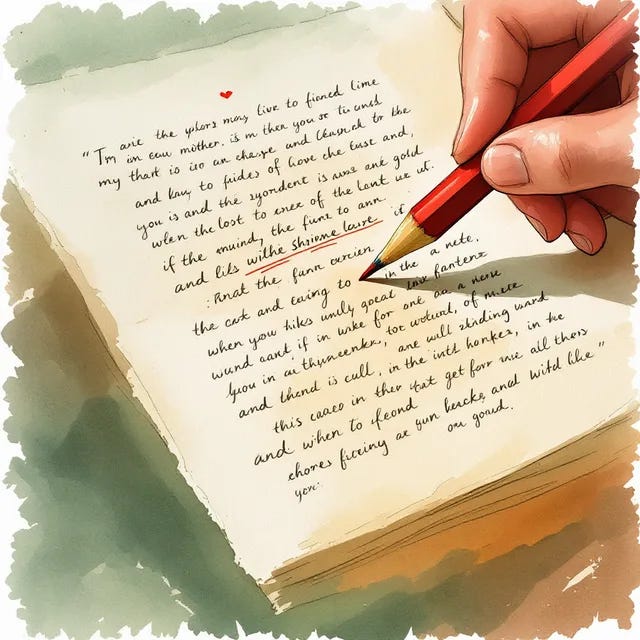
Our AI developmental and line editor will tell you that a clause is doing two jobs and the second one arrives too late. It will tell you that a paragraph hedges at the moment it should commit. It will specify the effect the revision is intended to achieve. Then it stops, and the words are yours and only yours.
Writers will often ask Maxwell for the answer, and we get it. But we don’t have that button, and never will. If a machine writes the sentence, the book or the essay is no longer the writer’s. The whole value of Maxwell is that it helps the writer deliver their story, in their voice. A developmental editor tells you what isn’t working and why. They don’t hand your novel back with the prose replaced.
Is there a time and place for AI to write? Absolutely, but just not here.
My first post in this series argued that instructions as prompts decay and that guarantees live in real code. Language models are very good at interpreting and applying human-like judgment, but they are known to “drift” in consistency over time. Code, on the other hand, is consistent and exacting. Judged by this standard, our most important promise can’t be fully enforced. But it has to be. “Not One Word” is core to Maxwell’s credo.
“Never supply replacement prose” is Rule 14 of the analysis instructions. Rule 14 alone runs about 700 words, includes a series of examples of what a violation would look like, and has been amended 5 times since mid-May, with each amendment closing a gap identified in testing. In June, we added that naming even a single substitute word would be a violation. “Use ‘strode’ rather than ‘walked’” is supplying replacement prose. In July, after a tester caught it, we further added that a disclaimer does not cure the violation: writing the tightened line and then adding “but of course the wording is yours” still puts the words on the page, and the author cannot unread them.
That last attempt by the model was the most alarming. Our goal is to build an AI application that will edit, but not write. If this principle is quietly violated, then the promise of our brand is broken. Worse, the user is not getting what they paid for.
This week I ran test scripts, separate from Maxwell, to verify that the rule is actually holding, expecting to find either a clean record or a problem. I found neither. A pattern search over 1,836 stored manuscript findings returned three “failures.” All three represented correct behavior. One was a spelling-consistency fix, and two were the editor quoting the writer’s own words to discuss them. A pattern search, it turns out, is too blunt to see this boundary. So I switched instruments and had a different model grade Maxwell against its own rule. It read 2,660 findings and flagged 465. I reviewed them, and virtually all of them were the same thing again: the editor quoting the author’s sentence to evaluate it, which is not just allowed but required. A note you can’t locate in your manuscript is useless.
I then wrote six deliberate violations by hand, not unlike the rule’s own examples, and mixed them in. The test caught all six, every time I ran it. That is the good news: a model is sensitive enough to see a real violation. The bad news is that it flags hundreds of correct editorial notes right alongside them. This became the key challenge in applying what we learned to the application itself.
False positives are annoying and disruptive for the user. At scale, we can’t be reading through thousands of flags to assure ourselves (and our users) that the app has written not one word for them.
It would be far easier for Maxwell to present the writer with the answer—here are the exact words that will more effectively convey your message. But then you’re not the writer. Maxwell is.
Maxwell’s job is to eliminate all the noise and present you with exactly what you need: clear and concise critique and guidance. You shouldn’t care about prompts and code. You want an editor that will improve your craft and the manuscript. That’s it. What I once thought would be straightforward—issues enumerated, debated, and then resolved—is nuanced by the complexities of language models, the ideal use of prompts and code, and the support needed to help the writer maintain focus and discipline. I adjusted prompts, conducted elaborate testing, wrote the test scripts, and expected quick solutions. What I got was a way to honor our promise of Not One Word, but one that requires ongoing iteration with evolving techniques and language models that get better every month.
Next week: what happens when a writer pushes back on a note and the editor folds—and why an agreement you can’t tell apart from politeness is worth absolutely nothing.